Microsoft FY27 Strategy: Decoded for Microsoft 365 Partners
FY27 pays for the upgrade, not for holding the account. Attach the security stack and the same customer book earns five times the flat run-rate. Both upgrade paths, enterprise and SMB, the Microsoft funding you can claim today, and what to move before October.
- softspend
- specialisations
- Frontier Accelerate Partner
- Agentic Partner Capability Score
- Frontier Partner Specialization
- SMB Copilot bundles
- Business Premium
- Microsoft FY27
- Microsoft Incentives FY27
- Microsoft Rebates FY27
- Microsoft Funding FY27
Microsoft's FY27 Strategy: Decoded for Microsoft 365 Partners
Microsoft has spent three fiscal years rearchitecting its partner model towards growth. In FY27, which runs from 1 July 2026 to 30 June 2027, Microsoft committed to the transition, with an aligned GTM framework, aligned suite architecture, the incentive rate card and the funding programmes now all point to one goal: move tenants up the Microsoft 365 stack, and get paid for the movement rather than for holding the account.
Microsoft is steering partners toward six strategic workload conversations across the book: Microsoft Entra ID, Microsoft Defender, Microsoft Purview, Microsoft Intune, Microsoft 365 Copilot and Microsoft Agent 365. Not every tenant needs all six immediately, but every tenant should now be assessed against them.
Short version
A flat indirect reseller book now earns materially less than it did. Flat Business Standard and legacy Office 365 run-rate no longer have a Microsoft 365 Core lever for indirect resellers. Business Premium still earns through Strategic Tier 1, but the old Core subsidy is gone.
The same customer book earns more when strategic security workloads are attached, up to 19.5% per eligible workload. FY27 pays for the upgrade motion, not for passively holding the account.
Core is the secure foundation: Entra ID, Defender, Purview and Intune licensed, configured and used. Frontier is the AI layer that sits on top: Copilot, Agent 365, Copilot Studio and agentic solutions.
Enterprise and SMB follow the same pattern, but not the same packaging. Enterprise moves through E3, E5 and E7. SMB moves through Business Standard, Business Premium, Defender Suite for Business Premium, Purview Suite for Business Premium and Copilot Business.
The enterprise upgrade motion is E3 at $39, E5 at $60 and E7 at $99, subject to current commercial price list validation. Each rung increases the plan depth across identity, security, compliance, endpoint management, Copilot and agent governance.
The SMB upgrade motion is Business Standard at $14, Business Premium at $22, then Defender and Purview suite attach where the security and governance gaps justify it. The SMB suite attach is not the same as E5, but it is the practical SMB analogue of the E3 to E5 security conversation.
E7 became generally available in FY27 planning materials as the new enterprise top tier. It packages E5 with Copilot, Entra Suite and Agent 365. Validate availability, Teams variants and pricing in softspend before quoting.
The SMB Copilot bundles did not simply expire with the early promotional period. Business Standard with Copilot and Business Premium with Copilot are now standing SMB bundle positions, subject to Microsoft's current price list and promotion terms.
Agent 365 should not be reduced to "E5 required" in every scenario. The safer position is that Agent 365 requires a qualifying security foundation. E5 is the cleanest enterprise route, E7 includes Agent 365, and Business Premium with qualifying Defender and Purview suite capability may form part of the SMB pathway.
Growth margin is separate from Microsoft Commerce Incentives, and arrives in October 2026. The FY27 rate has not been published.
Microsoft has announced two FY27 recognition paths: the Agentic Partner Capability Score and the Frontier Partner Specialization. They sit at different depths. The first is a capability-score route. The second is a high-bar specialisation route with prerequisite specialisations, skilling and audit.
The partner money is increasingly in services. Microsoft incentives can help fund the motion, but the durable margin is in assessment, remediation, deployment, adoption and managed services.
What standing still now costs
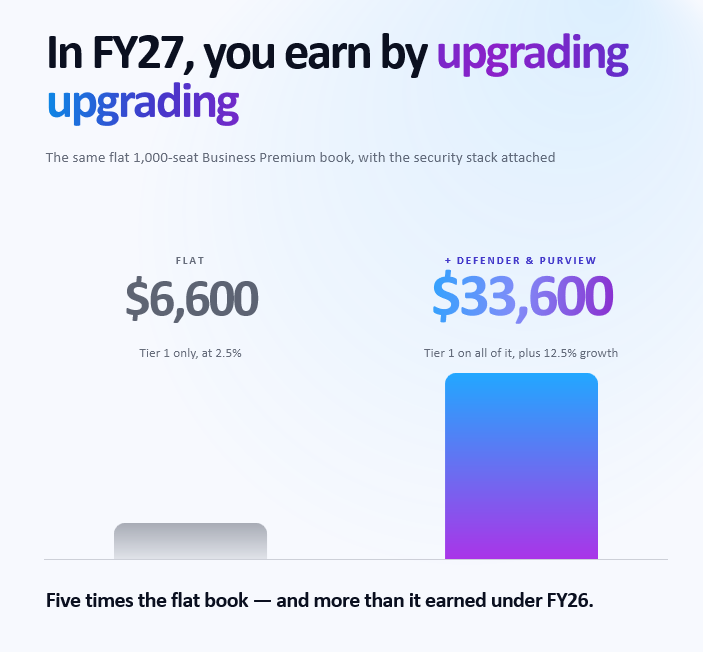
Take an indirect reseller with a book of 1,000 seats. The table below runs the same book three ways: flat on Business Standard, flat on Business Premium, and Business Premium with the Defender and Purview suites attached. Left flat, it earns far less than it did in FY26, and on Business Standard nothing at all. Attach the stack and it earns about five times the flat position.
CSP Strategic Tier 1, the top band of Microsoft's Strategic Product Accelerator, is a flat global rate in FY27, so market bands affect funded engagement payments rather than the Microsoft 365 Strategic Tier 1 percentage.
The book | FY26 | FY27 | Change |
|---|---|---|---|
Business Standard, flat | $5,625, Core rebate only at 3.75% | $0, no lever applies | Gone |
Business Premium, flat | $17,820, Core rebate at 3.75% plus Tier 1 at 3% | $6,600, Tier 1 only at 2.5% | 63% less |
Business Premium with the Defender and Purview suites attached | n/a, the suites were not attached | $33,600, Tier 1 on all of it plus 12.5% growth | 5x the FY27 flat book |
The $33,600 example assumes the $15 security-stack attach is qualifying tenant-level year-on-year growth, with no offset from another partner, direct customer purchase, Enterprise Agreement decline or other revenue movement in the same solution area. If the tenant-level baseline does not show qualifying growth, the Growth Accelerator component does not pay.
The worst-hit book earns nothing. Flat Business Standard and Office 365 run-rate was never strategic, so it only ever earned core. With the reseller core rebate retired it now sits outside every lever. Two options per tenant: an upgrade plan into the strategic set, or a service price that no longer assumes the old rebate.
The pay for holding fell by roughly two thirds. Same book, same customers, same work. The core rebate quietly subsidised managed service margins for years, and that subsidy has ended.
The same book with the suites attached earns more than it did under FY26. That $33,600 is Strategic Tier 1 at 2.5% across the full $444,000 of annual revenue, plus the 12.5% Growth Accelerator on the $180,000 the suites add. FY27 pays for the upgrade, not for the relationship.
The FY27 rate card
Those numbers come off four levers. This is the Microsoft 365 CSP position for FY27, with caps applied per customer tenant, per lever, per partner.
Lever | Direct bill | Indirect reseller | Cap per tenant |
|---|---|---|---|
Core | 2.50% | Retired | $62,500 |
Strategic Tier 1: Business Premium, E3, Copilot Business, the with-Copilot bundles, Defender Suite, Purview Suite and the Business Premium suite variants | 2.50% | 2.50% | $62,500 |
Strategic Tier 2: E5, E7, Agent 365, Copilot and Copilot Studio | 7.00% | 7.00% | $175,000 |
Growth Accelerator: Tier 1 and Tier 2 products plus Windows 365 | 10.00% | 12.50% | $250,000 direct, $312,500 indirect |
Against FY26 that is Core down from 3.75% and gone entirely for indirect resellers, Tier 1 down from the old 3% to 4% market split, and growth up from 7.50%. The Defender and Purview suites, including the Business Premium variants, moved into Tier 1, and E7, Agent 365 and Copilot Studio joined Tier 2.
Core, then Frontier
Microsoft groups everything it wants partners to sell into two lanes. Core is the secure foundation: Microsoft Entra ID, Microsoft Defender, Microsoft Purview and Microsoft Intune licensed, configured and used. Frontier is the AI layer that runs on top of it. Copilot and agents expose the quality of the tenant’s identity, sharing, data protection, endpoint and governance posture.
Microsoft publishes guidance on these conversations with clients. However, it does not publish the mapping from each conversation to the licensing that delivers it and the work you get paid for. That mapping is below, so softspend have made it actionable for your team:
The enterprise and corporate version
Lane | The conversation | What delivers it | The work you sell |
|---|---|---|---|
Core | AI-ready productivity and security for every employee | E3, then E5. Entra, Defender, Purview and Intune stepped to P2 | Baseline hardening, the E3 to E5 upgrade, posture assessment |
Core | Modernise with confidence | Windows 365, Intune P2, endpoint modernisation | Device and desktop modernisation, VDI migration |
Core | Establish a trusted and secure platform for AI | The E5 security stack, plus the Entra Suite at E7 | Copilot readiness, Zero Trust, oversharing remediation |
Core | Build a unified, governed data and AI estate | Microsoft Fabric, Purview across the estate | Data estate work, mostly outside the Microsoft 365 stack |
Frontier | AI in the flow of human ambition | Copilot as an add-on, or bundled in E7 | Copilot deployment, adoption and change management |
Frontier | Amplify your intelligence | Copilot grounded on Work IQ | Grounding, content readiness, usage measurement |
Frontier | Agentify your business processes | Agent 365, Copilot Studio, Microsoft Foundry | Agent build, governance, credit consumption forecasting |
Frontier | Ubiquitous innovation | GitHub Copilot, Microsoft Foundry | Developer enablement, mostly outside the Microsoft 365 stack |
The SMB version, for organisations below 300 seats
Four sales conversations, all of them selling from the Microsoft 365 stack you already resell.
Lane | The conversation | What delivers it | The work you sell |
|---|---|---|---|
Core | Run your business securely | Business Premium $22, then the Defender and Purview Suites at $15 combined | Security baseline, posture assessment, managed detection and response |
Core | Modernise your data for AI | Purview in Business Premium. SharePoint and OneDrive hygiene | Oversharing remediation, permissions clean-up, classification |
Frontier | Secure AI in your flow of work | Copilot Business $21, or the with-Copilot bundles at $23.50 and $32 | Readiness assessment, the Copilot in 30 trial, adoption and conversion |
Frontier | A competitive edge with AI | Copilot Studio and agents on Copilot Chat, with Agent 365 at $15 per user for governance | Agent build, connector and data governance |
Secure the tenant first. AI does not remove the need for identity, data and endpoint controls. It exposes where they are weak.
Frontier does not sell without Core underneath it. That readiness gap is where the services opportunity sits.
The enterprise stack
The enterprise stack is broadly positioned as Microsoft 365 E3, Microsoft 365 E5 and Microsoft 365 E7. Microsoft increases plan depth across identity, security, compliance, endpoint management, Copilot and agent governance as customers move up the tiers.
Workload | E3 ($39) | E5 ($60) | E7 ($99) |
|---|---|---|---|
Entra (identity) | ID P1, Conditional Access | ID P2, risk-based access | Entra Suite: identity governance, Zero Trust network access, Verified ID |
Defender (threat) | P1, baseline protection | Defender Plan 2 across endpoint, identity, email and cloud apps | As E5, extended to agents |
Purview (data) | P1, information protection and DLP | P2, insider risk, premium eDiscovery and audit | As E5, extended to agent activity |
Intune (devices) | P1, device management | P2, advanced endpoint controls | As E5 |
Copilot | Copilot Chat only | Copilot Chat only | Included |
Agent 365 | Not eligible | Eligible, add at $15 per user | Included |
E7 is the new enterprise top-tier position above E5. At $99, it is intended to package E5 with Copilot, Entra Suite and Agent 365 at a lower combined price than buying those components separately.
At enterprise scale, E5 is the cleanest foundation for the Frontier conversation. It gives the customer the Entra ID P2, Defender and Purview depth that Copilot, agent governance and advanced security discussions tend to require. It is not the only possible Agent 365 prerequisite route, but it is the simplest enterprise route to explain and defend.
The SMB upsell pathway
This is the upgrade pathway most MSPs actually work with day to day, and it gets far less coverage than the enterprise conversation. Arguably there has never been a better time to position upgrades in the SMB market.
Workload | Business Standard ($14) | Business Premium ($22) | Plus Defender and Purview Suites (+$15) |
|---|---|---|---|
Entra (identity) | Basic identity, no Conditional Access | ID P1, Conditional Access | ID P2, risk-based access |
Defender (threat) | Exchange Online Protection only | Defender for Business, Defender for Office 365 P1 | Endpoint P2, Identity, Cloud Apps |
Purview (data) | No Purview information protection or DLP | Information protection and DLP | Insider Risk Management, eDiscovery Premium |
Intune (devices) | Not included | Plan 1 | Plan 1. Advanced endpoint management needs the separate Intune Suite |
Copilot | Copilot Chat | Copilot Chat | Copilot Chat |
Agent 365 | Not eligible in this pathway | Eligible, add at $15 per user | Eligible, add at $15 per user |
Business Standard is not a security baseline. It gives the customer productivity apps and baseline email protection, but it does not provide Conditional Access, Intune device management or the same data protection foundation as Business Premium. Every Business Standard tenant should now be reviewed as an upgrade opportunity, especially for indirect resellers where static non-strategic run-rate no longer earns through the Microsoft 365 Core lever.
Microsoft Defender Suite for Business Premium and Microsoft Purview Suite for Business Premium are the SMB security and governance attach motion. They are not equivalent to E5. They strengthen the Defender and Purview layers, but they do not automatically add Entra ID P2. If the customer needs risk-based Conditional Access, Entra ID Protection, Privileged Identity Management or advanced identity governance, price Entra ID P2 or Entra Suite separately.
Business Premium is a qualifying prerequisite for Agent 365, so an SMB customer does not have to move to E5 to start the agent governance conversation. The remaining barrier is commercial rather than technical. Per user pricing built for the enterprise does not land in a fifty seat tenant, and we expect an SMB priced entry point to follow. Until it does, scope the specific Agent 365 capabilities the customer actually needs and validate the prerequisite position in softspend before quoting.
Copilot is now a 'base' SKU for SMB
Copilot for Business can be purchased as a standalone add-on for eligible SMB customers, and Microsoft also offers business plan bundles that combine Microsoft 365 Business plans with Copilot.
Plan | Price | What it does for the deal |
|---|---|---|
Business Standard with Copilot | $23.50 | Copilot without the security baseline. Fine for a small pilot on a clean tenant, and a weaker position to defend at review |
Business Premium with Copilot | $32 | Copilot on the secure foundation. Both halves sit in strategic Tier 1, and the deal lifts the strategic-to-base ratio that growth margin measures |
Copilot Business, standalone add-on | $21 | Attaches to Basic, Standard or Premium. Useful when the base plan is not moving this cycle |
All available to new and existing customers, 1 to 300 seats, on annual commitment.
Lead with the $32 Premium bundle. It lands the security baseline and AI in one transaction, and it is the only route that puts Copilot on a tenant that already has Conditional Access, device management and data classification foundation underneath it.
The commercial argument for you is not the customer's saving. It is that both halves of that SKU sit in the strategic set, the deal moves the tenant's mix ratio in the direction growth margin rewards, and the security position it creates is the thing that makes the Copilot deployment defensible at the first review.
Conversely, Business Standard with Copilot puts Copilot on an estate with no Conditional Access and no data classification. This licensing bundle turns an existing oversharing problem into a visible one.
Two new Copilot trials
Used well, both trials build pipeline. They give you a reason, and a deadline, to open a Copilot conversation with every Microsoft 365 Business customer in your book. They also surface whatever the tenant has not fixed. Copilot grounds against the content each user can already reach, so sharing defaults, Conditional Access, audit and data classification all get tested in front of end users before anyone has reviewed them.
Attach a softspend Copilot readiness assessment from the outset and both halves work together. The trial creates the demand, the assessment scopes and prices the remediation behind it, and the customer sees a partner running a framework rather than one switching on a licence.
Copilot in 30 is a limited-time, partner-led motion rather than a licence you resell. It went generally available on 3 August 2026 and has been transactable in CSP New Commerce since 1 August 2026, under product ID CFQ7TTC0MM8R and SKU ID 006Z. The offer runs through 31 December 2026, so it is a dated opportunity.
What the customer gets is a 30-day Copilot Business trial for up to 25 users, scoped to organisations under 300 employees on a qualifying Microsoft 365 Business subscription: Business Basic, Business Standard or Business Premium. What you get is the framework around it: a launch kit of campaign and customer-facing assets, customer targeting through ASPX and CloudAscent, setup and adoption content, conversion guidance, and a 30-day success planner. From mid-August a customer evaluation tool adds industry-specific prompts and scenarios, so the trial produces structured feedback rather than impressions.
You choose the tenant, so you can check readiness before the clock starts.
The Low Friction Trial (LFT) is the reactive play, set out in Message Center post MC1338815. An eligible end user starts a 30-day trial themselves from Copilot Chat, with no payment details and no admin purchase decision. It is on by default for eligible tenants: SMB customers up to 300 seats, users without a paid Copilot licence, and self-service trials left enabled. Rollout to SMB began in early July 2026.
The detail that matters is which Copilot it grants. This is Microsoft 365 Copilot (Premium), not Copilot Business, so it is grounded in the tenant content each user can already reach, with agents such as Researcher and Analyst included. Every trial start does raise a license request in the Microsoft 365 admin center, so the signal exists, but it lands somewhere most partners are not watching. If a customer is not ready, the control is Settings, Org settings, Self-service trials and purchases. We covered that shift and the debt it creates in Microsoft Just Made Copilot Free to Start. The Bill Is Governance.
Either way, Copilot lands on a tenant whose Conditional Access, sharing defaults and data classification you may never have audited. A trial that stalls on oversharing is rather harder to recover from than one that starts a fortnight later. Better to run the readiness check before the clock starts, and convert on what it tells you.
An SMB Agent 365 entry point
Microsoft Agent 365 is widely misunderstood because early partner messaging was presented as “E5 required”. The more accurate position is that Agent 365 requires a qualifying security foundation.
From 1 June 2026, new Agent 365 purchases should be checked against the qualifying prerequisite list in Product Terms. E5 is the cleanest enterprise foundation, but Business Premium with qualifying Defender and Purview suite pairings also qualifies where Product Terms confirm the scenario.
E7 is unaffected, because it packages E5, Copilot, Entra Suite and Agent 365 together.
The practical consequence is important: agent governance can start from an SMB customer where the qualifying security foundation is in place. A partner who reads the original “E5 required” headline too narrowly risks excluding their Business Premium base from the agent governance conversation.
Agent 365 is the control plane for observing, governing, managing and securing agents. It does not stand on its own. The governance model depends on the controls underneath it: Entra ID for identity and access, Defender for protection and detection, and Purview for data governance and compliance.
That is the logic behind the prerequisite. Microsoft is no longer simply gating a feature for commercial reasons. It is requiring a security and governance foundation because agent control depends on identity, threat protection and data protection being in place.
Do not assume every customer running agents already qualifies. Every customer running agents should be assessed against the Agent 365 prerequisite list, the required security foundation and the capabilities they expect it to provide.
Microsoft’s wording is also worth handling carefully: customers without a qualifying position may not have access to certain Agent 365 capabilities. That is softer than a universal hard block, so verify the Product Terms and the softspend platform before quoting.
FY27 partner recognitions
Microsoft has announced two new partner recognitions for FY27. They sit at different depths. One accelerates the points that earn a designation. The other is a 'top tier' specialisation with a third-party audit behind it.
Agentic Partner Capability Score | Frontier Partner Specialization | |
|---|---|---|
For | Partners across the AI Cloud Partner Program who can demonstrate agent build and delivery capability | Services and channel partners delivering agents across Microsoft's Frontier stack |
What you need | No prerequisites published | Four prerequisite specialisations, five Frontier Transformation Engineer badges and three DP-600 holders, all under one Partner Global Account |
Measured on | Three named components. Usage: agent monthly active users. Value: agent consumption. Trust: governed, secure agent delivery. Thresholds not published | A third-party audit across design, build, deploy, govern and secure, revalidated every two years |
What it unlocks | Accelerated progress toward Partner Capability Score recognition, and where Microsoft confirms the mechanics, faster progress toward designation or capability-score-based eligibility. It is not, by itself, a rebate. | Expected to support Frontier-aligned co-sell, Microsoft Agent prepurchase plan credits, E7-related product benefits, packaged go-to-market, badging, priority visibility and Concierge support, subject to Microsoft’s final FY27 rules. |
Documentation status | Announced. | Requirements published in full in a dedicated Microsoft post. Opens for enrolment later in FY27 |
What to do now | Start capturing agent MAU, consumption and evidence of governed delivery across your book. You cannot plan a date, but you can instrument for the measures | Audit which of the four prerequisite specialisations you already hold, and cost the DP-600 and audit gap before committing |
Both are scheduled to arrive during FY27. The Frontier Partner Specialization opens for enrolment later in the year. The Agentic Partner Capability Score has been announced.
Microsoft's SMB partner content labels the capability score "for SMB focused partners" and the specialisation "for services and channel partners," which has been widely read as a segment rule. However, the programme material does not support that reading. The Agentic Partner Capability Score was announced as an "AI Cloud Partner Program" update, open to eligible partners who can demonstrate agent build and delivery capability, with no published segment restriction.
The update is better read as guidance on what is realistically attainable rather than as an eligibility gate. However, the practical outcome is much the same either way, because the Frontier Partner Specialization requires an Azure specialisation, three DP-600 holders and a third-party audit, which puts it out of reach for most SMB practices on capability grounds rather than on segment grounds.
Do not assume you are excluded from the capability score because of the customers you serve.
The Agentic Partner Capability Score looks like a badge, but it is better understood as a capability-score accelerator. Partner Capability Score is one of the mechanisms Microsoft uses to award Solutions Partner designations. In FY27, that matters because designations remain a key eligibility signal for incentives, funded engagements and customer credibility. For CSP indirect resellers, Microsoft also recognises a 25-point capability-score route for CSP transaction incentive eligibility in the relevant solution area.
Get your Frontier badge now
Two things are being discussed under the Frontier label, and they should be separated before partners read the requirements and assume the whole motion is out of reach.
The Frontier Partner badge already exists, and partners already hold it. Its entry bar is three Solutions Partner designations (SPD): Modern Work or Business Applications, Security, and a Cloud and AI Platform-aligned designation, plus three specialisations: Copilot, Data Security, and one of AI Apps on Microsoft Azure, AI Platform on Microsoft Azure or Accelerate Developer Productivity.
That badge is evolving into the Frontier Partner Specialization. If the question is whether any of this is reachable from where you sit today, the badge is the near-term answer to get started.
Next up: Frontier Partner Specialization
Three components must be met at the same time, under the same Partner Global Account:
Four prerequisite specialisations: Copilot, AI Apps on Microsoft Azure or AI Platform on Microsoft Azure, Data Security, and Identity and Access Management.
Skilling: five people must hold the "Frontier Transformation Engineer" badge, and three people must hold "Fabric Analytics Engineer Associate" (DP-600). They can be the same people or different ones.
Audit: a third-party audit validating delivery capability across design, build, deploy, govern and secure, on a two-year cadence.
The "Frontier Transformation Engineer" badge underneath it validates building agents across Microsoft Foundry, Copilot Studio, Copilot, GitHub Copilot, Microsoft Fabric and Agent 365, and is earned through certifications, advanced training and project-ready execution rather than an exam alone. An incredible achievement for your team members.
Three of the four prerequisite specialisations are already within reach of a Microsoft 365 practice. Data Security and Identity and Access Management sit in your stack. Copilot is the motion you are already selling. The fourth is AI Apps or AI Platform on Microsoft Azure, and the DP-600 requirement adds Fabric on top of that.
On the stated requirements, the Frontier specialisation is not reachable from a Microsoft 365 practice alone. That is a strategy decision rather than a skilling one. Reaching it means building or buying Azure and Fabric capability, then carrying a third-party audit every two years, which is a different business from the one most Microsoft 365 practices are running today. If that is not the direction you are taking, the three prerequisites that already sit in your stack are worth holding on their own merits, and the Frontier Partner badge remains the near-term position.
The specialisations behind your motion
"Select Modern Work or Security specialisations" is how Microsoft words the eligibility line on its funded pre-sales engagements. It does not name which ones. For a practice built on Microsoft 365 security and Copilot it resolves to five. The table below pairs each specialisation with the licensing motion it sits against in SMB and enterprise, so you can see which funded work you could nominate for today and which specialisation you would have to earn to reach the rest.
Workload | Specialisation | SMB pathway | Enterprise pathway |
|---|---|---|---|
Entra ID | Identity and Access Management (Security) | Entra ID P1 through Business Premium, then P2 with the Defender Suite | E3 to E5, then the Entra Suite at E7 |
Defender | Threat Protection (Security) | Defender for Business, then the Defender Suite alongside Business Premium | Defender for Endpoint P1 at E3 to P2 at E5, extended to agents at E7 |
Purview | Data Security (Security) | Sensitivity labels and DLP in Business Premium, then the Purview Suite | P1 at E3 to P2 at E5, extended to agents at E7 |
Copilot | Copilot (Modern Work) | Copilot Business and the with-Copilot bundles | The Copilot add-on, E7, and Agent 365 |
The readiness work | Secure AI Productivity (Modern Work) | Readiness before a Copilot in 30 trial converts | Readiness before the E5 or E7 decision |
Business Premium-level Defender and Purview capability is not the same as Defender Suite, Purview Suite or E5 compliance capability. Read the SMB column as a starting position rather than an equivalent.
Modern Work and Security each cap product benefits at three specialisations. The cap applies to product benefits only: a fourth still counts for funded engagement eligibility and co-sell positioning.
Specialisation criteria
Every specialisation is gated on four requirements at once, and on a fifth where the specialisation requires it.
Eligibility, the aligned Solutions Partner designation (SPD) for that solution area.
Performance, a threshold measured from customer telemetry rather than from your claims. For the Copilot specialisation this is now paid "Copilot monthly active usage", which is deployment reality rather than seats sold.
Skilling, meaning the Microsoft-published certification, applied-skills or badge requirements held by the required number of named people. Certification lists change, so validate the current requirements before building a hiring or exam plan around them.
Validation, which may mean customer evidence or third-party audit depending on the specialisation and timing. Copilot, Azure-aligned specialisations and the Security specialisation family are moving more clearly toward independent validation, so budget for audit cost and preparation where Microsoft requires it.
Marketplace. A fifth pillar now applies where the specialisation calls for it. Some newer specialisations require a published Microsoft Marketplace offer tagged to the relevant products. Treat this as a 'fifth gate' only where Microsoft’s specialisation rules require it.
That performance gate is the part that catches practices out. You cannot certify your way into a specialisation on a book that is not deploying, which means the specialisation and the upgrade motion have to be built at the same time. softspend can help you build that advisory pipeline and costed upgrade proposals to close the gap.
Impact on pre-sales
This is where partner commentary often diverges, because the answer depends on which FY27 programme you are nominating.
At enterprise scale, assume select Modern Work or Security specialisations may be required. FY27 funded engagements such as "Frontier Accelerate Security: Envisioning & POC", "Frontier Accelerate Security deployment accelerators" and related conversion motions can carry specialisation, performance and Partner Performance Accountability requirements as well as customer eligibility rules.
At SMB scale the bar is lower. The Business Premium deployment accelerator and the Business Premium Defender and Purview suite accelerator are separate programmes, and both gate on a Solutions Partner designation rather than a specialisation. Most established partners already hold the designation, so check the named accelerator before assuming you need to earn anything.
Either way, specialisation changes the commercial conversation. A partner with the relevant specialisation can often nominate Microsoft-funded work that another partner has to price itself.
FY27 renamed these engagements by putting Frontier Accelerate in front of the existing name, so Security: Envisioning and PoC becomes Frontier Accelerate Security: Envisioning & POC. The funding guide abbreviates the prefix to FA, and the tables below follow it. Frontier Accelerate engagements run 1 July 2026 to 30 June 2027.
What unlocks what
Two credentials are routinely confused: Solutions Partner designations and specialisations. They support different motions.
What you need | What it supports | |
|---|---|---|
1. Solutions Partner designation | 70 points on the Partner Capability Score, or the 25-point route Microsoft recognises for CSP indirect resellers in the relevant solution area. Plus the revenue threshold: $1M trailing twelve months for direct bill, $25K for indirect resellers, both measured across the Partner Location Account and the IDs under the Partner Global Account, with indirect counting same-country IDs only | Microsoft Commerce Incentives eligibility, meaning the rebate and co-op on everything you already transact. The Business Premium accelerators and conversion bonuses are also reported as designation-gated, though that conflicts with the deck above |
2. A Modern Work or Security specialisation | The aligned designation, plus performance, skilling and validation | The three funded engagements: Envisioning and PoC (300+ seats), the CSP Deployment Accelerator (50+ incremental seats) and the Conversion Bonus. Each names a Modern Work or Security specialisation as its partner eligibility |
3. Frontier Partner Specialization | The four prerequisite specialisations, five Frontier Transformation Engineer badges, three DP-600 holders and a third-party audit, all under one Partner Global Account | Frontier-aligned co-sell eligibility, Microsoft Agent prepurchase plan credits, E7 licensing, packaged go-to-market, badging and priority search |
Two things follow from that table.
A designation gets you through the door. The Solutions Partner designation, or the recognised 25-point capability-score route for indirect resellers, satisfies a key partner eligibility gate for CSP transaction incentives. It does not guarantee earnings. Those still depend on eligible products, customer eligibility, revenue classification, Partner of Record, trailing twelve-month revenue, Change of Channel Partner status and programme caps.
A specialisation gets you the funded work. Where Microsoft wants proof of advanced delivery capability, a partner holding Data Security, Threat Protection, Identity and Access Management, Cloud Security or Copilot can often nominate funded pre-sales, readiness or deployment work that another partner has to price itself. Seat minimums, licensing prerequisites, Proof of Execution rules and engagement-specific gates still apply.
That is what the Agentic Partner Capability Score is worth. It moves you toward designation or capability-score eligibility, which is a real commercial lever, but it is not a rebate.
The money moves from promotions to margin
There are promotions running now, and they are worth using, but do not build the whole FY27 plan around promotional pricing. Promotions are temporary customer discounts. Margin is the gap between buy price and sell price. Microsoft Commerce Incentives are paid after billing through rebate and co-op. Growth margin is a separate margin construct, not an MCI incentive.
Microsoft has signalled an October 2026 margin shift on strategic Microsoft 365 products and a base-margin reduction on selected legacy products. Treat the detailed growth-margin mechanics, including seat thresholds, mix tests, pass-through and stacking, as items to verify with Microsoft or your distributor before quoting.
Motion | In plain terms | What qualifies |
|---|---|---|
New-to-offer | The customer has never had this product before | New to the tenant, 300+ seats |
Seat expansion | The customer buys a lot more of something they already have | 1x increase, 300+ seats |
Strategic SKU mix | Most of the customer's estate is now on the premium products | 80% strategic-to-base ratio, 300+ seats |
Eligibility is assessed at tenant level across every channel and partner, so "new to offer" means new to the customer rather than new to you, and nothing in your CRM will automatically tell you that unless you have the tenant connected by a platform like softspend.
And eligibility locks at the time of sale, with no true-up and no retrospective claim. A Defender Suite deal quoted at 280 seats instead of 300 is a permanent margin decision made in pre-sales. That is the argument for quoting from a standardised proposal rather than an ad hoc one.
What actually changes on 1 October
Two things happen on the same day:
What happens | |
|---|---|
The opportunity | Growth margin arrives on E5 and E7, Copilot, the Defender and Purview suites, and Windows 365. It is upfront margin on the "buy price" to the CSP, rather than a rebate paid weeks later, it sits on top of base margin, and importantly, it stacks with the growth accelerator on the same deal. |
The risk | Base margin falls by around 5% on a set of legacy and standalone products: Office 365 E1 and E3, Exchange Online, SharePoint, OneDrive extra storage, and Microsoft 365 Apps for Business and for Enterprise. |
The legacy book becomes less profitable to hold on the same day the strategic book becomes more profitable to grow. A partner who does nothing between now and October ends the quarter earning less on the same customers.
For SMB accounts, the 'growth margin' is not eligible as a top-up. That makes the licensing upgrade motion, the co-op fund and the MCI deployment fees more important for SMB partners. This is where softspend can help scale your advisory engagements and drive the upgrade proposals across your book.
Put it next to the FY27 rate card: flat Business Standard and legacy Office 365 run-rate already earn an indirect reseller nothing under the retired Core lever. If the expected base-margin reduction applies to the same legacy book from October, the commercial case for upgrade becomes stronger. Verify the exact margin impact with your distributor before committing a forecast.
One caveat worth checking: we understand that the growth margin passes through the distributor and direct bill tier. If you are an indirect reseller, what actually reaches you depends on what your distributor passes through and at what rate. That is a question to ask in writing before you build a plan on it.
How growth is actually measured
Growth is measured at the customer tenant, against all prior-year revenue in that tenant and solution area, regardless of which partner earned it or whether it came through a lapsed Enterprise Agreement (EA).
The practical consequence: a genuinely new sale does not automatically register as growth. If revenue from another partner in the same tenant declines while yours rises, the decline can offset your gain. Revenue that simply moves between channels without creating net new spend is not growth at all. Visibility at tenant level is recommended.
If your FY27 targets were built on new logos and expanding accounts, they may not be measuring what Microsoft will pay you on.
Services upsell
Motion | Partner services and solutions opportunity | Service attach | CSP incentive |
|---|---|---|---|
Secure AI productivity | $43.85 per user per month, up 2% year on year | 39% average | Up to 19.5% per eligible workload |
Microsoft Security (CSP) | $30.40 per user per month, growing 23% year on year | Around 70% of the opportunity is services | Included above |
Source: Forrester Total Economic Impact partner opportunity analyses commissioned by Microsoft, 2025 and 2026.
The 19.5% is Strategic Tier 2 at 7.00% plus the indirect Growth Accelerator at 12.50% on the same workload, which is why the ceiling only applies where the tenant shows qualifying growth.
Licence margin is around 30%. Services margin is 60% to 70%. FY27 has removed most of what used to subsidise the licence-only model.
Around 40% of CSP incentive is paid as co-op, which is a marketing fund you claim against approved activity rather than straight cash. That is available budget for the pre-sales work that finds deals in the first place, and most partners under-claim it (it is a use it or lose it model).
Where the money sits across the deal lifecycle
Most partners work all four stages below, but only two of them are funded. The other two come out of your own margin.
Stage | What it is | How it is funded |
|---|---|---|
01 Demand and marketing | Campaigns, client briefings | Co-op, the 40% half of your CSP incentive |
02 Advisory and assessment | Tenant assessment, envisioning, security workshops | MCI advisory above 300 seats, co-op advisory below it |
03 Transaction | Quote structure, seat thresholds, term, timing | Margin (%) on the licensing deal. This is the earning stage. Base margin, the strategic and growth accelerators, and from October growth margin |
04 Deployment and adoption | Rollout, security deployment, Copilot adoption | MCI deployment accelerators and conversion bonuses |
Stage 03 is where the commercial structure is fixed. Licence margin is realised through buy/sell economics. CSP transaction incentives are earned later through Microsoft Commerce Incentives, subject to eligibility, revenue classification and caps. Any October growth margin should be modelled separately as a margin construct, not as MCI.
Microsoft funding: MCI versus co-op
Co-op is contingent and must be claimed. For Microsoft 365 CSP transaction incentives, the earning split is generally 60% rebate and 40% co-op. The co-op portion requires the dollar threshold, approved activity, Proof of Execution and claim submission inside the relevant window. It is not guaranteed cash, and unclaimed eligible co-op can be forfeited.
Co-op play | What it pays |
|---|---|
Demand campaign (paid media with multi-touch) | Up to around 50% of your fund, no activity cap |
Client briefings (customer workshops) | Around $750 per briefing, no cap |
Sales skilling (internal partner skilling) | Around 10% guidance, no cap |
Proof of value (customer solution adoption) | Actual cost, 5% cap |
MCI activity funding is a fixed fee Microsoft pays for a qualifying completed client engagement. You nominate before you start, the customer and partner gates must be met, Proof of Execution is required, and size minimums apply. (softspend can automatically map MCI funding to your clients, and provide client reports to support proof of execution)
MCI play | What Microsoft pays per client |
|---|---|
FA Security: Envisioning & POC | $2,000 to $15,000 |
FA Copilot: Envisioning & POC | $2,000 to $25,000 |
FA AI-Ready Productivity: ME3 Envisioning & POC | $2,000 to $25,000 |
FA AI-Ready Productivity: CSP BP Deployment Accelerator, plus FA Security: CSP BP Defender/Purview Deployment Accelerator | $2,000 + $2,000, plus a conditional $1,600 switch bonus |
Deployment accelerators (Security, Copilot, Business Processes) | Fixed by size, to $100,000 |
Fees shown at Market A, which includes the UK. Markets B and C pay 75% and 50%. Envisioning is capped per tenant at two approved and one concurrent claim per fiscal year, counted across both variants. One trap to check before you plan a security pipeline: under the Repeat Engagement Delivery Policy, any tenant that took three or more FY26 security workshops is excluded from FY27 security pre-sales altogether.
What you can claim now
Worth pulling out separately, because it is the part most partners assume is closed to them.
Co-op is available to you right now. Any CSP partner accruing on CSP sales earns it, at any client size, with no specialisation and nothing that has to be deployed. The only gate is your own $10,000 semesterly balance. That funds the demand campaign, the client briefings at around $750 each, the sales skilling and the proof-of-value work.
Business Premium incentives via your Solutions Partner designations.
These split into separate motions. The FA AI-Ready Productivity: CSP BP Deployment Accelerator is tied to incremental Business Premium seats and the Modern Work designation gate. The FA Security: CSP BP Defender/Purview Deployment Accelerator is tied to qualifying Defender and Purview for Business Premium suite deployment and the Security designation gate. Where both qualify, the funded engagement value can reach $4,000 before any conditional conversion bonus. Do not assume both apply to every 50-seat Business Premium deal. The conversion bonuses are separate and conditional. The productivity conversion bonus is tied to Google Workspace displacement. The security conversion bonus is tied to the relevant security competitor displacement under the Security programme. Each depends on its own parent Deployment Accelerator, same-tenant and same-partner rules, timing, Proof of Execution and competitor evidence.
One activity, one funding source. Work Microsoft pays for under MCI cannot also be claimed from co-op.
Over 300 seats for MCI-funded pre-sales. The MCI envisioning engagements carry a 300 seat floor at their smallest size, so in SMB the readout runs as a co-op client briefing or proof of value instead. The deployment money is still MCI.
Take advantage of your Solution Partner designation. The SMB Business Premium accelerator gates on an active "Modern Work" designation for the deployment and a "Security" designation for the suites. Those are designations, not specialisations, which means most established partners can claim that stack today.
The pre-sales engagements are the ones that need a specialisation: FA Security: Envisioning & POC needs one of "Cloud Security", "Identity and Access Management", "Threat Protection" or "Data Security". FA Copilot: Envisioning & POC needs the Copilot specialisation, which becomes mandatory from 1 January 2027 once JumpStart Ready+ stops being honoured. FA AI-Ready Productivity: ME3 Envisioning & POC needs "Identity and Access Management" or "Modernize Endpoints", which is worth knowing if you sell the Intune pathway, because "Modernize Endpoints" also gates the Cloud Endpoints and Windows 365 engagements.
The assessment is what unlocks that funding, so it should not be priced as overhead.
Get on Marketplace
"Frontier Accelerate for Marketplace" arrives in September 2026 and folds ISV Success, Marketplace Rewards, Azure IP co-sell and certified software designations into one experience, across three stages: build and publish, grow sales, and differentiate. The headline benefits are Azure sponsorships up to $30K, $400K and $2M by stage, MACC decrement for your end-customers.
Most of that is an ISV motion rather than Microsoft 365 services. The part that matters to everyone is less known: co-sell recognition is moving to a Marketplace-first model, with Marketplace billed sales becoming the primary auditable way partner impact on a deal gets recognised. If you have IP of any kind, a managed service wrapper or a packaged assessment, listing it stops being a side project.
What to do now
Inventory the six strategic workloads. For every tenant, record the plan level and activation state of Entra, Defender, Purview, Intune, Copilot and Agent 365 with softspend. That table is your FY27 pipeline.
Treat every Business Standard tenant as an upgrade conversation. It carries no Conditional Access, no device management and no data classification, and it now earns you very little to leave alone. Use softspend to identify all Business Standard tenants, and do '1 Click' upgrade proposals.
Lead SMB Copilot with the Business Premium bundle at $32. It costs less than buying the parts and it lands the customer on the security baseline at the same time. Use softspend to automatically provide an upgrade proposal, with optimum bundles, and promos automatically.
Attach the Defender and Purview suites where the security and governance gaps justify them. The $15 combined position is the SMB analogue of the E3 to E5 security conversation, but it is not equivalent to E5. Use an assessment to drive the business case.
Lead with the agent question. Position E5 and Business Premium security upgrades on agent governance. Every customer with agents in production should be assessed against the Agent 365 prerequisite list.
Structure growth deliberately. Deployment Accelerator eligibility depends on incremental paid seats and the relevant high-water mark rules. Growth Accelerator eligibility depends on tenant-level year-on-year revenue growth across the solution area. A renewal alone is not enough.
Review your book for seat thresholds before October. Growth margin is locked at the point of sale, with no true-up and no retrospective claim, so a deal quoted just below a threshold loses it permanently. Re-check any E5, E7, Copilot, Defender Suite, Purview Suite or Windows 365 deal sitting near one before you quote it. The thresholds and rates themselves are not yet published, so confirm those with Microsoft or your distributor before you commit a number.
Audit which specialisations you hold against the funding you want to use.
Enterprise pre-sales engagements generally need a Modern Work or Security specialisation. The SMB Business Premium accelerators need only a Solutions Partner designation, which most established partners already hold. Where an engagement does call for a specialisation you do not have, you are quoting work that a specialised competitor can have Microsoft pay for.Run Copilot in 30 trials with a readiness check attached. The trial is now live and partner-delivered. Twenty-five seats on an unaudited tenant is a governance problem you want to find in week one rather than week five.
Price your legacy book before October. Office 365 E1 and E3, Exchange Online, SharePoint and Microsoft 365 Apps lose around 5% of base margin. Each of those tenants needs an upgrade plan or a services price that no longer leans on the old margin.
Ask your distributor, in writing, what growth margin they pass through. The construct is built at their tier. Confirm whether this is being passed through or not.
Get tenant visibility of your client book. Growth accelerator, growth margin, propensity and readiness are all decided on facts about the tenant rather than your billing system.
Where softspend fits
FY27 rewards one capability above all others: knowing every tenant in the book well enough to find the next move, price it, and provide fact based business case for the upgrade, before the deal is transacted.
That is what softspend is built for. Our framework-led assessments run across the whole book with read-only access and return feature-level activation state across Entra, Defender, Purview, Intune, and Microsoft Apps, Copilot rather than a licence count, scored against Copilot readiness, CIS and Zero Trust at the same time. Every gap is mapped to the licensing that closes it and priced, so the assessment gives the customer a priced action list rather than a list of problems.
On the commercial side, Deal Economics in the platform models the FY27 levers per deal with the eligible funding mapped, so the October growth margin question becomes a pricing decision rather than a discovery exercise.
softspend is a pre-sales delivery platform for Microsoft partners. It can produce the scorecard, the ranked gaps, the costed upgrade proposal, and the mapped Microsoft promos and MCI funding available to Partners. Those are the artefacts a client attests against and the ones that make a co-op or MCI claim go in clean. The outputs are "claim ready". The platform is how you produce them at book scale.
One tenant can be worked by hand. A book cannot, and FY27 is the year that difference shows up in the P&L.
References
FY27 partner GTM sessions: Executing the AI Frontier, Lead the GTM Shift, Lead the AI Shift, CSP Security Sales, Run Your Business Securely, Agent Governance (Microsoft, partner access required)
Microsoft 365 E7 and Agent 365 general availability: https://techcommunity.microsoft.com/blog/microsoft_365blog/microsoft-365-e7-and-agent-365-are-now-generally-available/4516295
Microsoft partner announcements, July 2026: https://learn.microsoft.com/en-us/partner-center/announcements/2026-july
Microsoft 365 business plans with Copilot, pricing: https://www.microsoft.com/en-us/microsoft-365/business/with-copilot-plans-and-pricing
Defender Suite for Business Premium: https://learn.microsoft.com/en-us/microsoft-365/admin/security-and-compliance/add-defender-suite-business-premium
Business Premium security overview: https://learn.microsoft.com/en-us/microsoft-365/admin/security-and-compliance/m365b-security-overview
Frontier Partner specialization, coming in FY27: https://techcommunity.microsoft.com/blog/specialisation-blog/coming-soon-the-frontier-partner-specialisation/4540152
Frontier Partner specialization overview: https://aka.ms/FrontierPartnerSpec
Frontier Transformation Engineer badge and partner skilling: https://aka.ms/FrontierPartnerSkilling
Accelerating Frontier Transformation with Microsoft partners: https://blogs.microsoft.com/blog/2026/04/21/accelerating-frontier-transformation-with-microsoft-partners/
MCAPS Start for Partners FY27: https://partner.microsoft.com/en-us/blog/article/mcaps-start-for-partners-2026
softspend, Paid to Grow, Not to Hold: FY26 vs FY27 CSP incentives: https://softspend.com/community/post/paid-to-grow-not-to-hold-fy26-vs-fy27-csp-incentives
Microsoft partner specialisations overview: https://learn.microsoft.com/en-us/partner-center/membership/specialisations
Microsoft partner incentives: https://aka.ms/partnerincentives
Microsoft CSP promotions readiness guide: https://aka.ms/CSPPromoGuide
Prices are shown in USD per user per month on the FY27 partner-deck basis and must be validated in softspend before quoting. Public annual-commitment list pricing, Teams variants, regional terms and promotional pricing may differ. Microsoft 365 Business plans cap at 300 seats per tenant. Microsoft Agent 365 is a separate SKU from Microsoft 365 Copilot unless included through a qualifying suite such as Microsoft 365 E7. The $15 Microsoft Agent 365 figure is indicative and should be verified before quoting.
The Frontier Partner Specialization and the Agentic Partner Capability Score were announced as FY27 recognition paths. Treat detailed requirements, benefit mechanics and enrolment timing as subject to Microsoft’s final published rules. Growth margin is a margin construct, not Microsoft Commerce Incentives. FY27 growth margin rates and final mechanics are unavailable in the funding guide, so verify with Microsoft and your distributor before building forecasts around them.
Promotions are customer savings, not partner revenue. Promotional discounts can reduce billed revenue and therefore reduce the CSP incentive base. Co-op is contingent accrued value, not guaranteed cash. Microsoft-funded engagements require nomination, eligibility, Proof of Execution and compliance with the relevant programme terms.
#MSPartner #CSP #MSP #Microsoft365 #FY27 #MicrosoftCopilot #Agent365 #MicrosoftPurview #MicrosoftDefender #MicrosoftEntra #BusinessPremium #softspend
Key Takeaways
- This article by Tony Mackelworth, CEO of softspend, reads Microsoft's FY27 partner strategy through the six Microsoft 365 workloads a CSP or MSP actually sells: Entra, Defender, Purview, Intune, Copilot and Agent 365.
- It argues FY27 is an alignment rather than a rate change, with the go-to-market framework, suite architecture, incentive rate card and funding programmes all rewarding movement up the Microsoft 365 stack rather than holding the account.
- A worked example shows what standing still costs an indirect reseller with 1,000 seats: a flat Business Standard book earns nothing in FY27 once the Core rebate is retired, a flat Business Premium book falls from $17,820 to $6,600, and the same book with the Defender and Purview suites attached earns $33,600.
- The framework is set out as two lanes, Core (Entra, Defender, Purview and Intune licensed, configured and used) and Frontier (Copilot, Agent 365 and Copilot Studio on top), with separate enterprise and SMB packaging.
- The enterprise ladder runs E3 at $39, E5 at $60 and E7 at $99, with plan depth increasing across identity, security, compliance, endpoint management, Copilot and agent governance.
- The SMB pathway runs Business Standard at $14 to Business Premium at $22, then the Defender and Purview suites at $15 combined, with Business Premium with Copilot at $32 as the bundle to lead with.
- It corrects a widely reported error on Agent 365: Business Premium is a qualifying prerequisite alongside E5, so agent governance can start on an SMB tenant, and the remaining barrier is commercial rather than technical.
- Two Copilot trials are covered: Copilot in 30, a partner-led 25-user, 30-day trial available in CSP New Commerce through 31 December 2026, and the self-service Low Friction Trial, which grants Microsoft 365 Copilot (Premium) and is on by default.
- On funding it separates Solutions Partner designations, which gate CSP transaction incentives, from specialisations, which gate the Frontier Accelerate funded engagements, and sets out the co-op and MCI plays a partner can claim today.
- It covers the 1 October 2026 shift, when growth margin arrives on E5, E7, Copilot, the Defender and Purview suites and Windows 365 while base margin falls around 5% on legacy products, and closes with the actions to take before then.
Key Facts
- FY27 runs from 1 July 2026 to 30 June 2027, and FY27 Frontier Accelerate funded engagements run for the same period.
- The CSP Core rebate falls from 3.75% in FY26 to 2.50% for direct bill partners in FY27 and is retired entirely for indirect resellers, so flat non-strategic Microsoft 365 run-rate now sits outside every lever.
- CSP Strategic Tier 1, the top band of the Strategic Product Accelerator, becomes a flat global 2.50% in FY27, replacing the FY26 market split of 3% to 4%, so market bands affect funded engagement payments rather than the Tier 1 percentage.
- The CSP Growth Accelerator pays 10.00% for direct bill partners and 12.50% for indirect resellers in FY27, up from 7.50%, with per-tenant caps of $250,000 and $312,500, and depends on qualifying tenant-level year-on-year growth in the same solution area.
- CSP incentive on the secure AI productivity motion reaches up to 19.5% per eligible workload, being Strategic Tier 2 at 7.00% plus the indirect Growth Accelerator at 12.50%.
- On a flat 1,000-seat Microsoft 365 Business Premium book an indirect reseller earned $17,820 in FY26 through the Core rebate at 3.75% plus Tier 1 at 3%, and earns $6,600 in FY27 through Tier 1 alone at 2.5%, a fall of 63%.
- A flat 1,000-seat Microsoft 365 Business Standard book earned $5,625 in FY26 through the Core rebate and earns nothing in FY27.
- The same 1,000-seat Business Premium book with the Defender and Purview suites attached earns $33,600 in FY27: Strategic Tier 1 at 2.5% across $444,000 of annual revenue plus the 12.5% Growth Accelerator on the $180,000 the suites add.
- Microsoft groups FY27 selling into two lanes: Core, meaning Microsoft Entra, Microsoft Defender, Microsoft Purview and Microsoft Intune licensed, configured and used, and Frontier, meaning Microsoft 365 Copilot, Microsoft Agent 365 and Copilot Studio running on top.
- The enterprise stack is Microsoft 365 E3 at $39, Microsoft 365 E5 at $60 and Microsoft 365 E7 at $99 per user per month.
- Microsoft 365 E7 packages Microsoft 365 E5 with Microsoft 365 Copilot, the Microsoft Entra Suite and Microsoft Agent 365.
- Microsoft Agent 365 is not eligible on Microsoft 365 E3, can be added to Microsoft 365 E5 at $15 per user per month, and is included in Microsoft 365 E7.
- The SMB pathway runs Microsoft 365 Business Standard at $14 and Microsoft 365 Business Premium at $22, with the Defender and Purview suites for Business Premium at $15 combined.
- Microsoft 365 Business Standard does not include Conditional Access, Microsoft Intune device management or Microsoft Purview data classification.
- Business Standard with Copilot is $23.50 and Business Premium with Copilot is $32 per user per month, with Copilot Business available standalone at $21, all for 1 to 300 seats on annual commitment.
- From 1 June 2026 a new Microsoft Agent 365 purchase requires one of the qualifying prerequisite positions in Product Terms: Microsoft 365 E5, A5 or Business Premium, or the Microsoft Defender Suite and Microsoft Purview Suite pairing, including the Education and frontline variants.
- Microsoft 365 Business Premium qualifies for Microsoft Agent 365 in its own right, so agent governance can start on an SMB tenant without moving to Microsoft 365 E5.
- Microsoft Agent 365 governance is delivered through Microsoft Entra for identity and access, Microsoft Defender for protection and detection, and Microsoft Purview for data governance and compliance.
- Copilot in 30 is a partner-led 25-user, 30-day Microsoft 365 Copilot Business trial, generally available on 3 August 2026 and transactable in CSP New Commerce from 1 August 2026 under product ID CFQ7TTC0MM8R and SKU ID 006Z.
- Copilot in 30 is a limited-time offer available in CSP New Commerce through 31 December 2026, built for organisations with fewer than 300 employees on a qualifying Microsoft 365 Business Basic, Standard or Premium subscription.
- The Low Friction Trial, set out in Message Center post MC1338815, is a self-service 30-day Microsoft 365 Copilot (Premium) trial that an eligible end user starts without payment details, on by default for eligible tenants up to 300 seats.
- Each Low Friction Trial start raises a license request in the Microsoft 365 admin center, and the trial is managed or disabled under Settings, Org settings, Self-service trials and purchases.
- FY27 funded engagements are named under the Frontier Accelerate brand, abbreviated FA in the funding guide, and the FY26 security workshops are retired.
- Funded engagement fees are quoted at Market A, which includes the UK; Market B pays 75% of Market A and Market C pays 50%.
- FA Security: Envisioning and POC pays $2,000 to $15,000 at Market A and requires one of the Cloud Security, Identity and Access Management, Threat Protection or Data Security specialisations.
- FA Copilot: Envisioning and POC pays $2,000 to $25,000 at Market A and requires the Microsoft 365 Copilot specialisation, which becomes mandatory from 1 January 2027 when JumpStart Ready+ ceases to be honoured.
- FA AI-Ready Productivity: ME3 Envisioning and POC pays $2,000 to $25,000 at Market A and requires the Identity and Access Management or Modernize Endpoints specialisation.
- The SMB Business Premium engagements pay $2,000 for the deployment accelerator and $2,000 for the Defender and Purview suites accelerator, with a conditional $1,600 conversion bonus, and gate on active Modern Work and Security Solutions Partner designations rather than on specialisations.
- Envisioning engagements carry a 300-seat floor at their smallest size and are capped at two approved and one concurrent claim per tenant per fiscal year, counted across both variants.
- Under the Repeat Engagement Delivery Policy, tenants that took three or more FY26 security workshops are excluded from FY27 security pre-sales.
- A Solutions Partner designation requires 70 points on the Partner Capability Score; CSP indirect resellers can alternatively qualify through a 25-point capability score assessed monthly across the current and previous five months.
- The Microsoft Commerce Incentives revenue threshold is $1M trailing twelve months for direct bill partners and $25K for indirect resellers, measured across the Partner Location Account and the IDs under the Partner Global Account, with indirect counting same-country IDs only.
- Modern Work and Security each cap specialisation product benefits at three, but the cap applies to product benefits only, so a fourth specialisation still counts for funded engagement eligibility and co-sell positioning.
- The Frontier Partner Specialization requires four prerequisite specialisations, five Frontier Transformation Engineer badges, three Fabric Analytics Engineer Associate (DP-600) holders and a third-party audit on a two-year cadence, all under one Partner Global Account.
- Growth margin arrives on 1 October 2026 on Microsoft 365 E5, Microsoft 365 E7, Microsoft 365 Copilot, the Defender and Purview suites and Windows 365, as upfront margin on top of base margin.
- Growth margin qualifies through three motions, new-to-offer, seat expansion and strategic SKU mix, assessed at tenant level across all channels and partners and locked at the time of sale with no true-up.
- The FY27 growth margin thresholds, multipliers and values have not been published, so they should be confirmed with Microsoft or the distributor before quoting.
- From October 2026 partner base margin falls by around 5% on legacy and standalone products including Office 365 E1 and E3, Exchange Online, SharePoint, OneDrive extra storage and Microsoft 365 Apps for Business and for Enterprise.
- Growth margin is a margin construct built at distributor and direct bill tier and is separate from Microsoft Commerce Incentives, so what reaches an indirect reseller depends on distributor pass-through.
- Forrester puts the partner services opportunity at $43.85 per user per month for secure AI productivity and $30.40 per user per month for security, with around 70% of the security opportunity being services.
- Partner margin on a Microsoft licence is around 30% against 60% to 70% on services.
- CSP transaction incentives for Microsoft 365 are paid 60% rebate and 40% co-op; co-op requires a $10,000 semesterly balance, approved activity, Proof of Execution and claim submission inside the window, and is forfeited if unclaimed.
- Work funded by Microsoft under MCI cannot also be claimed from co-op.
- CSP Strategic Tier 2 pays 7.00% in FY27 and now includes Microsoft 365 E7, Microsoft Agent 365 and Copilot Studio, while the Defender and Purview suites, including the Business Premium variants, sit in Strategic Tier 1.
Sources
- https://techcommunity.microsoft.com/blog/microsoft_365blog/microsoft-365-e7-and-agent-365-are-now-generally-available/4516295
- https://learn.microsoft.com/en-us/partner-center/announcements/2026-july
- https://learn.microsoft.com/en-us/microsoft-365/admin/security-and-compliance/add-defender-suite-business-premium
- https://learn.microsoft.com/en-us/microsoft-365/admin/security-and-compliance/m365b-security-overview
- https://techcommunity.microsoft.com/blog/specialization-blog/coming-soon-the-frontier-partner-specialization/4540152
- https://blogs.microsoft.com/blog/2026/04/21/accelerating-frontier-transformation-with-microsoft-partners/
- https://partner.microsoft.com/en-us/blog/article/mcaps-start-for-partners-2026
- https://aka.ms/FrontierPartnerSpec
- https://aka.ms/FrontierPartnerSkilling
- https://aka.ms/partnerincentives
- https://aka.ms/incentivesguide
- https://aka.ms/CSPPromoGuide
- https://www.microsoft.com/solutionassessments
- https://aka.ms/AgentGovernanceAndSecurity
- https://softspend.com/community/post/paid-to-grow-not-to-hold-fy26-vs-fy27-csp-incentives
- https://softspend.com/community/post/end-of-an-era-how-microsoft-rebuilt-its-commercial-model-for-fy27
- https://softspend.com/community/post/15-zero-trust-microsoft-smb-security-economy
- https://softspend.com/community/post/smb-copilot-readiness-what-to-fix-first